
The Art of
Jackson Dainty

Gallery Three

Masters of Change

Introduction

Great artists, musicians, adventurers and athletes share the common bond of performance beyond the norm. They function out there and invite all of us to follow. The truly notable become Masters Of Change. Masters see and then see beyond. Masters hear and then hear beyond.

Masters have the gift that enables them to make their heightened understanding part of our common consciousness. Masters make us all more aware and therefore more alive.

This series is a celebration of Masters Of Change. It is a collection of portraits of some of the people who have furthered our perception, enhanced our listening, challenged our thinking and brought us joy. This is one man’s vision of the masters, and it attempts to capture universal beauty, truth and glory. This is a celebration of the highest achievement of expression that the Masters Of Change so generously give us.

Originals and Giclee fine art prints available in Gallery Three.
The original paintings of Masters of Change Series are available as complete set.
Contact Jackson for the price.

Claude Monet

Fine art Giclee print
Inquire about originals
18”x24”

Claude Monet

I have chosen some of his passions as a painter to put into this painting. The Japanese foot bridge at Giverny, the water lilies, the haystack in his hat and, of course, Rouen Cathedral. When he was obsessed with a certain thing such as the bridge and water lilies he painted them over and over – in different seasons, different light and using many different color interpretations. He also traveled and worked unceasingly on what he saw during his travels.

Gustave Geoffrey was one of the most versatile and respected writers on art of his generation: Geoffrey wrote reviews, books and catalogues about a number of contemporary painters and sculptors. He met Monet by chance during a visit to Belle Isle in 1886 and developed a great admiration for his work and a warm affection for Monet, the man. Their correspondence reviles Monets most incisive observations of his work. Here is a short letter to Geoffrey from Monet:

Heartfelt thanks for your two fine articles which I’m very proud of. No, I am not a great painter. Neither am I a great poet. I only know that I do what I can to convey what I experience before nature, and that most often, in order to succeed in conveying what I feel, I totally forget the most elementary rules of painting, if they exist that is. In short, I let a good many mistakes show through when fixing my sensations. It will always be the same, and this is what makes me despair.

Thank you for your great and loyal friendship and trust in the no less loyal friendship of your old

Claude Monet

Monet’s work is so beautiful. You never see the anxieties he speaks of here.


Why a Master

At the prestigious Paris Salons of the late 19th Century, Monet and his fellow impressionists were dubbed palette scrapers by critics. Undaunted by this scathing insult, the painters or impressionists as they called themselves, opened their own salon and the public soon ignored the critics. Perhaps one of the most significant and radical changes in the direction of art was the result. Out was sentimentality, out was heroic interpretation and in came light and air and space. Beauty in the flower, beauty in the garden. Beauty for beautys’ sake; filtered through the artists emotional and spiritual core.

Why a Master

At the prestigious Paris Salons of the late 19th Century, Monet and his fellow impressionists were dubbed palette scrapers by critics. Undaunted by this scathing insult, the painters or impressionists as they called themselves, opened their own salon and the public soon ignored the critics. Perhaps one of the most significant and radical changes in the direction of art was the result. Out was sentimentality, out was heroic interpretation and in came light and air and space. Beauty in the flower, beauty in the garden. Beauty for beautys’ sake; filtered through the artists emotional and spiritual core.

Andy Warhol

Fine art Giclee print
Inquire about originals
18′x24”

Andy Warhol

Andy Warhol was one of the most influential artists of the last number of decades. Of course, Warhol’s use of photography may be the most ground breaking aspect of his art. He incorporated photography through all his phases. His work was so graphically powerful it could only be Pop Art.
His Pop Art career began in the early 1960s along with other artists such as Roy Liechtenstein’s comic book panels and James Rosengnist’s mock billboards. His Campbell’s Soup cans, Coca Cola and Brillo box sculpture were definitely minimalism, but minimalism applied to the mundane was a new twist.

The four sections of the painting represent the aspects of his life and art. The upper left corner in black and white depicts him as a photographer of black and white photos. This was the foundation of his Pop Art.

Below that panel is Warhol exposed for everyone to see, he is naked, just as he lived his life.

In the upper right corner is my humorous take of Warhol’s humor. I call it “globe head,” kind of the world in his head!

Finally, the lower right panel represents the icon style of Pop Art that was his which captured the imagination of the pubic so strongly.

Why a Master

Ideally suited to his time, Andy Warhol lived a life that was as shocking and touchingly vulnerable as much of his art. Warhol grew artistically as American culture was in the throes of tumultuous change. In the midst of uncertainty he gave us Brillo boxes and posterized portraits of Hollywood legends; Campbell’s soup cans and Chairman Mao.

An admitted culture junkie, Warhol found beauty everywhere and led us to that beauty even when we were reluctant. He was the ultimate voyeur, a whitens to his time who gave us a fifteen minute glimpse into eternity.

Pablo Picasso

Fine art Giclee print
Inquire about originals
18”x24”

Pablo Picasso

After a number of contemplations on the man I believe I figured out why he was compelled to paint a face on a face on figures throughout his career. It was because he himself was two faced. All art is an expression on the inner content of the soul of the artist. At any rate, the muse has no moral standard, and the personal behavior of many artists have shocked society since the beginning of time. Picasso was a master shocker.
Here’s a short rundown on the evolution of my Picasso piece:

The area behind Picasso on the right side is from a painting named Seated Woman. It was painted in Paris, May 28th, 1946. I was doing a contemplation one morning and a voice said 1946. That’s all, just 1946. When I got up and turned on the radio the first thing that I heard was the temperature at the present time is 46 degrees. I ran to my Picasso book and found the painting, Seated Woman, from 1946, which became the upper right of the painting.

Behind Picasso on the left side is a portion of a painting named Girl Before a Mirror. Painted at Boisgelong, March 14, 1932. I like it’s color, his diamond pattern behind her, which he used in many of his works over the years; and the connection that the audience will make to it because this is a very familiar piece.

My concept of Pablo Picasso is a parody of his style. A face within a face. He also rearranged the anatomy of the faces he painted with the nose on the side and uneven eyes. Picasso tore down and rebuilt everything he painted just like he tore down and rebuilt all the important relationships in his stormy life.

Why a Master

The story is told that Picasso liked to stroll on the beach, drawing lines in the wet sand, so that the next wave would wash the lines away. It was his tribute to the eternity of art.

Picasso changed his style completely seven times in his long career. He gave us three dimensions in two and three dimensional sculpture that pointed the way to the fourth. Three decades after he left this life, Picasso is still pointing the way.

Duke Ellington

Fine art Giclee print
Inquire about originals
18′x24′

Duke Ellington

Here I’ve tried to incorporate a few parts of the life of a genius. They needed to be graphic and interesting to the viewer – a history on canvas.
In the background on his left are the images of dancers from a futuristic civil rights play titled Jump for Joy.

At the top on the right side is the sign from the famous Cotton Club in Harlem, and below that on the right border are stylized musicians that represent his orchestra. Their graphic look was taken from an old poster that advertised Duke Ellington at the Cotton Club performing Black and Tan Fantasy.

In the background above and to the right of Duke’s head is my version of a book by Duke Ellington titled Music Is My Mistress. The piano keys and the woman on the right are from a Broadway poster for Sophisticated Ladies.

Duke’s head is both the younger and older self. His coat is deep purple because he was the regal Duke. The sheet music in front of him is Black, Brown and Beige, which is what he believed to be his most important concert at Carnegie Hall, on January 23, 1943. That composition continued to be revised up to 1965 when he recorded it privately.

Duke used the phrase Beyond Category to describe his favorite exceptional artists. He truly was that himself.

Why a Master

Duke Ellington sang America’s glorious song even when America wasn’t necessarily listening. Calm and gracious in the face of the mindless integration laws and customs of the time, Ellington rose above all obstacles to give us soaring melodies and intricate time signatures that are now woven into the very fabric of our society.

Often writing at night on the train, he felt the rhythmic click of the tracks as he crossed the country, spreading his musical vision and broadening everyone’s musical horizons. Steeped in the European classical tradition, Ellington brought fourth a unique tradition of his own – the American song.

Amelia Earhart

Fine art Giclee print
Inquire about originals
18′x24”

Amelia Earhart

I use a stamp to tell my story of this Master of Change. She is a symbol of courage and vision. She was a very unique woman. A true American pioneer.

At the top of the painting is her Lockheed Electra set against stylized clouds. Behind Amelia in the background is a graphically simple map of the world with her route and stops along the way.

Amelia’s image itself is also stylized and is based upon two photos of her from the Smithsonian Institute. The price of the stamp (3¢) was the price of a regular first class stamp from 1933 -1958. The boarder of the stamp is cloud white while the background is blue/grey, representing the sky. The overall sepia tone of the painting is typical of illustration from her period.

Why a Master

Amelia Earhart grew up in an age when the list of things a lady didn’t do was extensive. A young girl could aspire to become a nurse, but never a doctor. Even wearing pants in public as cause for shock. Earhart broke all the molds. Her approach to life can best be explained by a poem she wrote titled Courage.

Courage

Courage is the price that life
Extracts for granting peace -
The soul that knows it not,
Knows no release from little things.
Knows not the livid loneliness
Of fear nor mountain heights
Where bitter joy and hear the
Sound of wings.

How can life grant us boon of living,
Compensate for dull gray ugliness
And pregnant hate unless we dare
The soul’s domain? Each time we
Make a choice we pay with
Courage – to behold restless day
And count it fair.

Vincent van Gogh

Fine art Giclee print
Inquire about originals
18”x24”

Vincent van Gogh

Vincent van Gogh touches the simple and deep caverns of the heart.  Each of his brushstrokes expresses the understanding of color and emotion. When he cast his unique eye on his favorite subjects – the ordinary working people – we see beauty where it was never found before.

The idea of this painting was to portray him within his own vision, using several of his styles and employing some of his favorite images.  The aqua blue sky is varied in tone under flower pedal-like clouds.  To his left is the olive orchard with several peasant women working.  At the bottom of the sky the bluish-purple mountains radiate their unique light.  On his upper right and below the mountains are the thatched cottages of the people.

Of course, the irises on his right are from those he painted in Saint-Remy. His straw hat is from a self portrait titled “Winter, Paris.”  The smock is from another self portrait he painted with pallet and brushes in hand.

Why a Master

No one exemplifies the suffering artist more than Vincent van Gogh. He sold very few paintings in his lifetime. Most of his work went to his brother, Theo. It was Theo’s widow, Johanna van Gogh – Bonger, who brought van Gogh to the publics attention not long after his death.

Today, van Gogh’s painting of sunflowers holds the record for sale at auction, selling for several million dollars. In his lifetime, he couldn’t give his work away.

He was the epitome of the tormented artist; suffering depression, alcoholism and lead poisoning (from his habit of putting wet brushes in his mouth). He was unlucky in love and always poor, yet he gave to the world a truly magnificent vision.

Vincent van Gogh painted with pain and painted through pain. Even through the pain of death he became the most recognized artist in the world

Vincent van Gogh II

Fine art Giclee print
Inquire about originals
18”x24”

Why Two van Gogh Versions?

My first try did not feel right. I’d stuck to the concept, incorporating key elements of the artist’s work, mimicked his brush work, used his favorite colors… It just did not feel right.

What did I miss? What was it about van Gogh did I not capture?

I stewed about this nagging question for weeks. Then the answer struck me like a bolt of lightning. Van Gogh, maybe more than any other artist, was his art. He strove and suffered – never selling more than several paintings in his life – and died unknown and ignored.

To paint him as a Master I had to do more than paint his portrait. I had to paint his art, his soul and his essence. That’s why van Gogh II portrays his image within his images. They are one and the same. They are eternal. He and his art are no longer unknown.

The funny thing is that many people who have viewed both images prefer van Gogh I. Some comment that van Gogh II is “dark.” I agree, it is a bit dark; but so was his mortal life. His life was a struggle from beginning to end. It was unrelenting in its challenge and misery. His legacy, his immortal state, is glorious. It is a triumph of beauty and spirit.

Georgia O’Keeffe

Fine art Giclee print
Inquire about originals
18′x24′

Georgia O’Keeffe

O’Keeffe wore black most of the time. She is wearing a head wrap that trails off her right shoulder. Her face is older with an eternal youthfulness. My style is graphic and logoized so her features feel that way. Behind her head is a luminous white Jasmine Weed flower from her painting of 1934.

On the left side of the flower are large leaves and on the right a particular fooling image that I stylized from her paintings. The sky is abstract with a birdlike image flowing in the motion of the sky.

Below O’Keeffe’s image are soft mounded hills, breasts-of-the-desert. Hidden in the hills on the left side of the painting is a little bottom. I don’t know if it’s sensual, but it adds some moonscape to the desert scene.

In the foreground is a bleached cow skull with scrub desert trees dappled through the mesa. She was her own person always, and I hope this painting captures that spirit.

O’Keeffe’s themes were unique to her art at the time of creation and they were masterfully executed. The boldness of her work in all aspects, from form to theme to color, and the abstract introduction of the landscape made her work truly unique. Her famous calla lilies and orchids were lush and mystical. Whatever she did, cityscapes to desert scapes, there was no mistaking her style and approach to the subject matter.

Her style was exclusively hers. The format of a bold flower with a swirling leaf wrapped around the stem like the curvaceous body of a woman clinging to her mate was all George O’Keeffe. She alone could capture the beauty of the sensuality of natures poetic organs painted in a magnified but delicate intensity.

Why a Master

Even at her level of artistry and mastership she was always concerned that her work was derivative. She was quoted at one time saying, Before I put brush to canvas, I question, is it mine? Is it intrinsically of myself? Is it influenced by some idea of photograph of an idea, which I have acquired from some man?

She needn’t have worried. O’Keeffe was the artist who gave all women power of expression. She made the female sexual sensual and allowed us all to see the glory in the beauty of woman and nature.

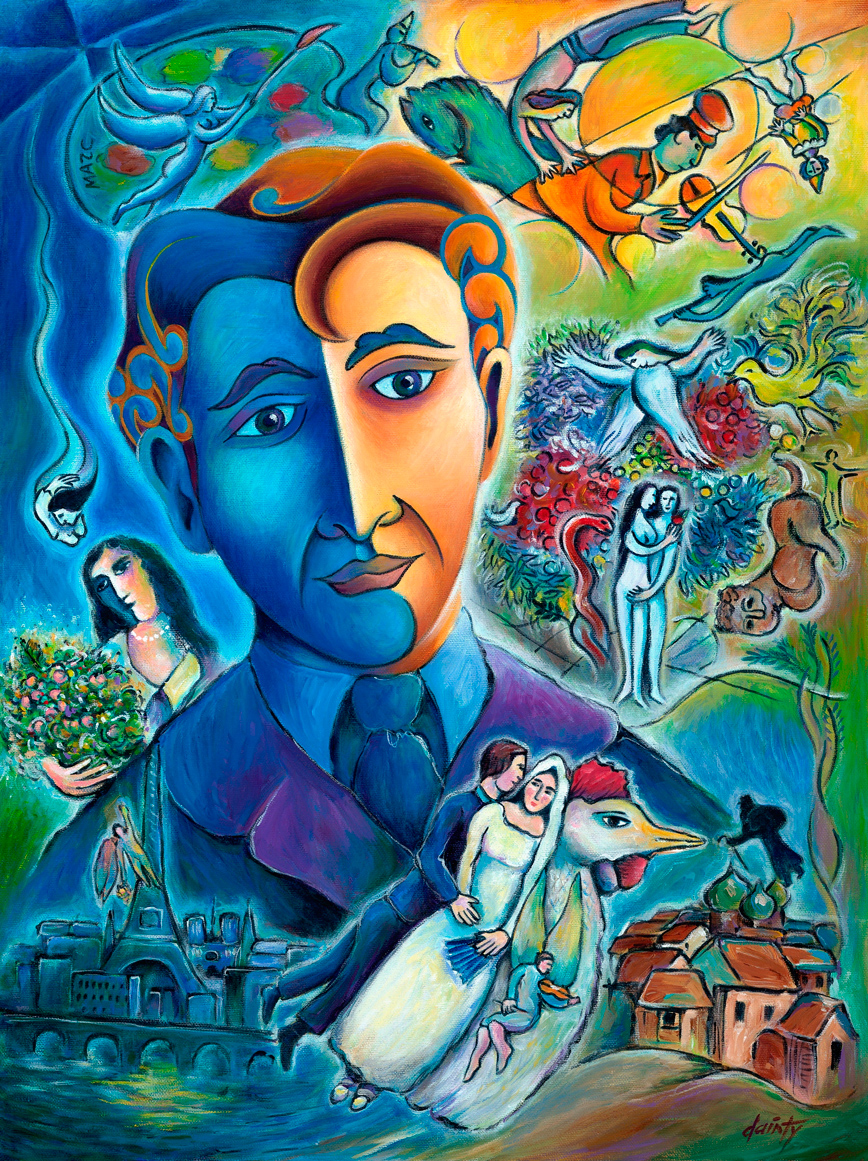
Marc Chagall

Fine art Giclee print
Inquire about originals
18”x24”

Marc Chagall

In the upper left corner is the artist’s palette which is heavenly inspired with an angelic figure holding a brush. Below the palette on the left is the ghost of Bella from the painting The Soul of the City (1945). On Chagall’s shoulder is his beautiful living Bella. She was much the subject of his art.

Above Chagall in the upper right corner is an example of his style of metamorphosis. A horse turns into a fiddler or is half horse, half fiddler in a circus scene, complete with a flying acrobat and a tipsy tightrope walker.

Below the circus is a portion of a painting named Paradise (1962). It is Adam and Eve in Eden, a place above time and space.

At the bottom of the painting is the unique image of a bride and groom riding a giant rooster. This scene is a partial version of Chagall’s painting The Lovers of the Eiffel Tower (1938-1939). It is a joyous image of Bella’s and Marc’s wedding. On the lower left of the scene is Paris with a flying angel near the famous Eiffel Tower.

The lower right is the Russian city of Vitebsk, Chagall’s birthplace. Above the town’s buildings is the image of the Wandering Jew, a symbol from the Diaspora Over Vitebsk (1915-1920).

Finally my representation of a youthful Marc Chagall. His blue side represents the mystical part of him, the deeper side of himself as an important aspect of his life and art. The lighter side displays the lightness of his being, which certainly shines through most of what he expressed.

So many beautiful flying figures from one master of change. You really must wonder if we also fly in our own art of dreams!

Why a Master

Don’t let that horse
eat that violin
cried Chagall’s mother

But he
kept right on
painting
And became famous

And kept on painting
The Horse With Violin in Mouth

And when he finally finished it
he jumped up on the horse
and rode away
waving the violin

And then with a low bow gave it
to the first naked nude he ran across

And there were no strings
attached.

by Lawrence Ferlinghetti
from: A Coney Island of the Mind
copyright 1958

..But he kept right on painting…
Chagall had no choice and he knew it. His world was phantasmagoric and mundane, whimsical and severe, dark and light. It is there for all to see. To really appreciate a Chagall is to let go of all perception of the so-called real world. You accept flight as fact and color as emotion. The Wandering Jew meets the cosmic circus and the results are breathtaking.